
How Hot Is Too Hot? What the Safety Standards Say About Shower Water
Most people know that hot tap water can scald. Far fewer know how quickly, or that there is a published American standard for how hot the water at a shower head is allowed to be. Both are matters of public record, and neither takes long to read.
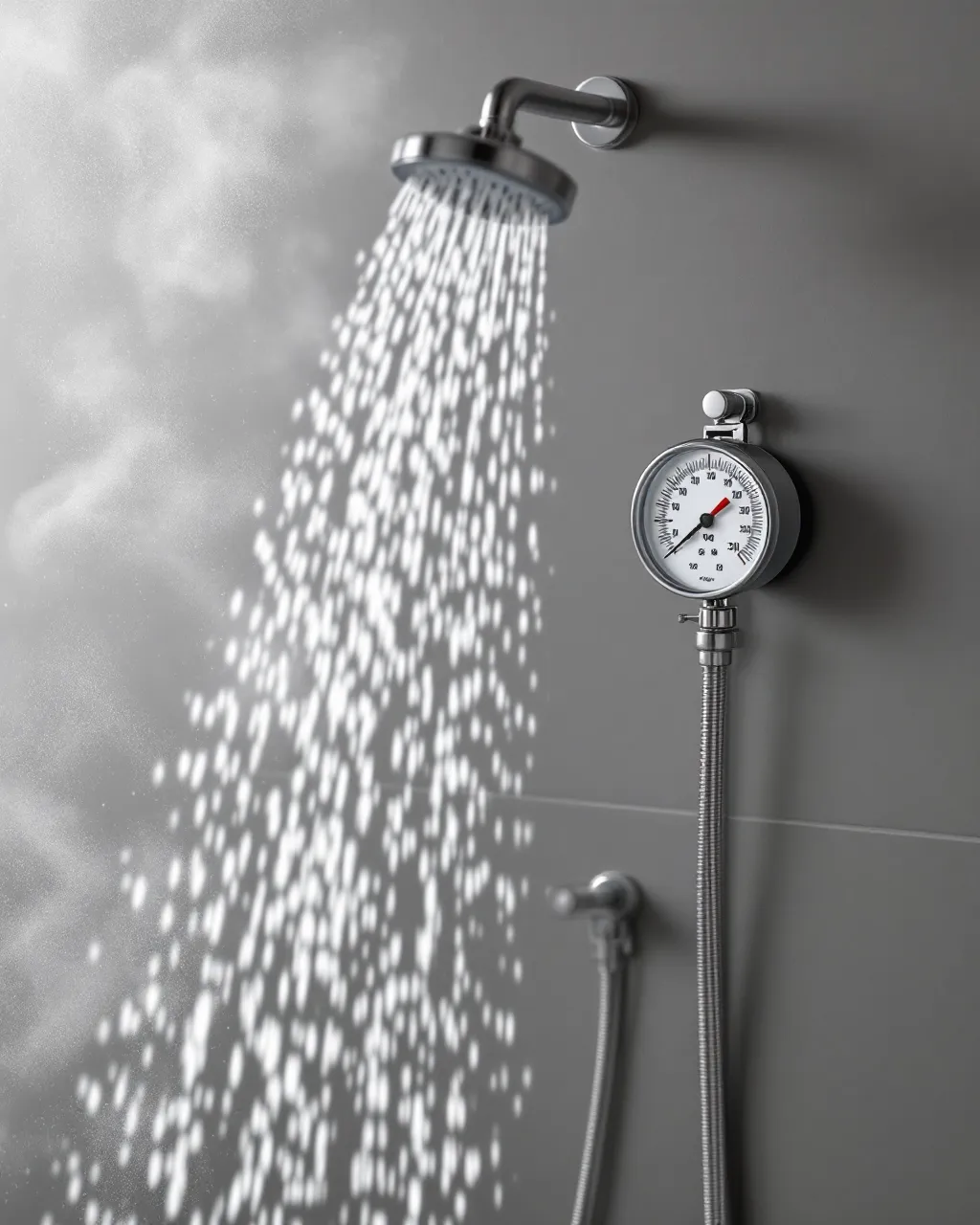
How fast does hot water cause a burn?
The US Consumer Product Safety Commission publishes the figures in Avoiding Tap Water Scalds, CPSC Publication 5098:
“Most adults will suffer third-degree burns if exposed to 150 degree water for two seconds. Burns will also occur with a six-second exposure to 140 degree water or with a thirty second exposure to 130 degree water. Even if the temperature is 120 degrees, a five minute exposure could result in third-degree burns.”
Laid out as a table, the pattern is easier to see:
- 150°F — third-degree burns in about 2 seconds
- 140°F — about 6 seconds
- 130°F — about 30 seconds
- 120°F — possible at about 5 minutes
Twenty degrees separates the top and bottom of that list, and the exposure time changes by a factor of roughly 150.
Who does it happen to?
The CPSC is specific on this point in the same publication: “The majority of injuries and deaths involving tap water scalds are to the elderly and children under the age of five.”
The Commission’s stated reasoning is about reaction time rather than skin. A scald requires noticing the water, deciding to move, and moving — and at 150 degrees the whole of that sequence has to happen inside two seconds.
Is there a written standard for shower water?
There is. Section 608.6 of the 2010 ADA Standards for Accessible Design states that “shower spray units shall deliver water that is 120°F (49°C) maximum.” The same clause requires a handheld spray unit on a hose at least 59 inches long, with an on/off control with a non-positive shut-off.
As with everything else in the ADA, that requirement applies to public accommodations and commercial facilities rather than private homes. It is the only published American figure for the question, which is why it is worth knowing.
Why 120 in particular?
Set the CPSC table beside the standard and the choice is legible. At 130 degrees the margin is half a minute. At 120, the CPSC’s own figure puts a third-degree burn at around five minutes of continuous exposure.
That does not make 120-degree water harmless, and the CPSC does not describe it that way. What it does is move the hazard from a timescale shorter than a reaction into one long enough that something has to go wrong for a considerable while first.
Our Warranty
Lifetime warranty covering plumbing, wall systems, fixtures, shower pan, doors and installation. Transferable to a new owner, backed by RenewItHQ, documented in writing. Only exclusion is customer damage.
What we are not going to tell you
We are not going to tell you that the fixtures in a RenewItHQ shower will prevent a scald. We do not hold a test report that would support that sentence, and every other number on this page is one you can check, so this is not the place to start making claims that are not.
The CPSC and ADA figures above are facts about bathrooms and about published standards. They stand entirely on their own, with no product attached to them.
What is actually in the wall and on the wall
What we can tell you is what the parts are.
The trim and valves are Delta commercial-grade fixtures — the specification built for a building that strangers use all day, going into a house that gets used a couple of times a day. The arithmetic on service life changes when the duty cycle drops by that much.
Behind the wall, the valves and connectors are brass. There is no plastic in the water path inside the wall. Brass is the material that belongs there: it is dimensionally stable, it takes a thread and holds it, it handles the thermal cycling a shower valve sees every day, and it is what commercial specifications have called for as long as there have been commercial specifications. The part of a bathroom nobody will ever be able to inspect is exactly the part where cheaper materials pay, which is the reason we do not use them.
A handheld comes as standard, on the same logic the ADA uses in section 608.6: water that can be directed is more useful than water that can only be stood under.
Where the numbers come from
Burn times and the population most affected: US Consumer Product Safety Commission, Avoiding Tap Water Scalds, CPSC Publication 5098. Shower water temperature limit and handheld requirement: 2010 ADA Standards for Accessible Design, section 608.6.
Talk It Through in Your Own Bathroom
We look at the space, answer the questions this guide raised, and explain the options that fit your home.

Ready When You Are