
The Fixture Nobody Remodels: Toilets and Bathroom Injuries
Nearly a quarter of every bathroom injury treated in an American emergency room happens at the toilet. Among people aged 85 and over, it is more than half. It is also the one fixture in the room the remodeling industry has the least to say about, and the one wall that usually goes back up with nothing behind it.
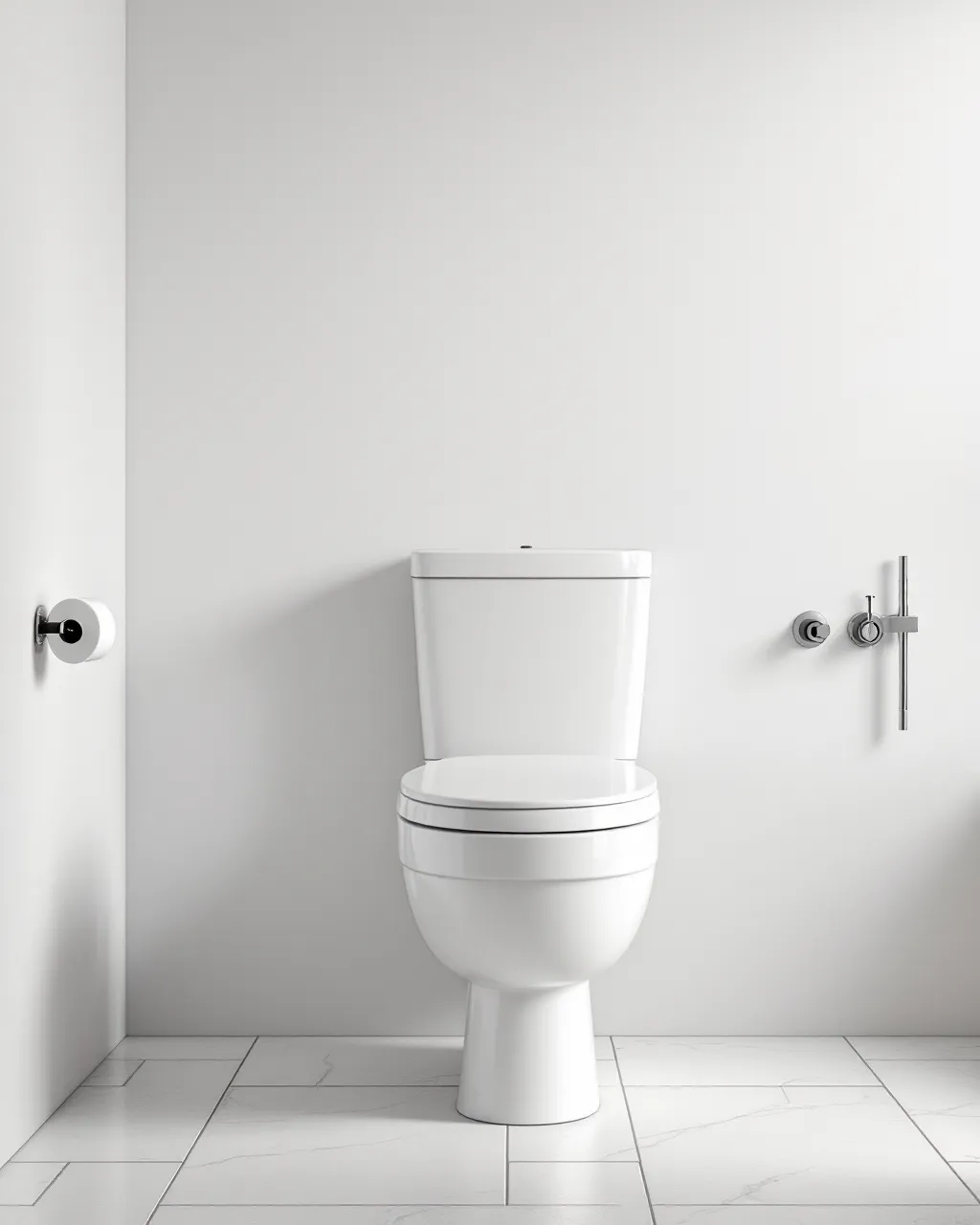
The figures come from the CDC’s Morbidity and Mortality Weekly Report, in a study by Stevens, Haas, and Haileyesus (MMWR, June 2011). It is the only national analysis that coded bathroom injuries by which part of the bathroom they happened in, which is what makes the toilet visible at all.
How much of the problem is the toilet?
Of 234,094 nonfatal bathroom injuries estimated nationally, 54,696 happened at the toilet. That is 23.4 percent, or close to one in four.
For comparison, the tub or shower accounts for 68.3 percent. Between them the two fixtures account for 91.7 percent of everything that happens in a bathroom. The sink is 1.2 percent.
Does that change with age?
More than any other figure in the study. The toilet is a minor part of the picture for young adults and the dominant one for the oldest.
As a share of each age group’s own bathroom injuries:
- Ages 15 to 24: tub or shower 84.5 percent, toilet 7.0 percent
- Ages 85 and over: tub or shower 38.9 percent, toilet 51.7 percent
Somewhere before 85, the toilet overtakes the shower and becomes the single most common place in the bathroom for an injury.
The rates make the same point on a different scale. Injuries on or near the toilet run at 4.1 per 100,000 at ages 15 to 24, and 266.6 per 100,000 at 85 and over. That is roughly a sixty-five-fold difference, and it is the fastest-climbing figure anywhere in the report.
Looked at by activity rather than location, standing up from, sitting down on, or using the toilet accounts for 14.1 percent of all bathroom injuries across every age. Among people 85 and over it is 36.9 percent.
What did the CDC say might explain it?
The report offered a possible explanation in its Editorial Note. This is a description of what the authors proposed, not advice, and not a statement about any particular person:
“Although less than 3% of older adult injuries were attributed to loss of consciousness, the injuries among persons aged ≥65 years associated with using the toilet might be attributed in part to vasovagal syncope. This condition is a common cause of fainting and can be brought about by urinating, having a bowel movement, or abdominal straining. Standing after prolonged sitting also can result in postural hypotension, a sudden drop in blood pressure that causes light-headedness or dizziness.”
The authors present that as a partial explanation, hedged with “might be attributed in part.” We are not going to extend it further than they did. Anything about what any of this means for a particular person is a question for a doctor, not a bathroom company.
Why does almost nobody build for it?
Partly because a toilet does not photograph well, and the remodeling industry sells with photographs. Partly because a shower is a large visible product with a large visible price attached and a toilet is a fixture swap. And partly because the data above is not widely known. The MMWR is fifteen years old and the toilet finding sits in a table most people never open.
Whatever the reason, the result is a category that spends its marketing budget on 68.3 percent of the problem and is close to silent on the other 23.4.
Our Warranty
Lifetime warranty covering plumbing, wall systems, fixtures, shower pan, doors and installation. Transferable to a new owner, backed by RenewItHQ, documented in writing. Only exclusion is customer damage.
What does the standard say about the toilet?
Considerably more than most homes contain. Section 604.5 of the 2010 ADA Standards requires grab bars on the side wall closest to the water closet and on the rear wall. The side wall bar has to be at least 42 inches long, positioned no more than 12 inches from the rear wall and extending at least 54 inches from it. The rear wall bar has to be at least 36 inches long.
Those requirements apply to public accommodations. A private home is not covered by the ADA at all, as the US Department of Justice sets out in its Title III Technical Assistance Manual: “title III does not apply to strictly residential facilities.”
The standard does contain a residential carve-out worth reading, at 604.5 Exception 2. In dwelling units, grab bars are not required “provided that reinforcement has been installed in walls.” The accompanying Advisory 604.5 defines what that reinforcement has to be capable of: it “must be sufficient to permit the installation of rear and side wall grab bars that fully meet all accessibility requirements including, but not limited to, required length, installation height, and structural strength.”
So even the exemption is really about blocking. The code’s answer to “a house does not need grab bars” is “then it needs the wood behind the wall so it can have them later.”
What does RenewItHQ do here?
Two things, and they are worth keeping separate.
The first is ordinary. We replace toilets as part of partial and complete bathroom remodels. That is a fixture swap, and we are not going to dress it up into a safety claim.
The second is the part almost nobody in this trade does. We set blocking at the toilet wall, not only at the shower. Where that wall is part of the job, timber goes in behind it while it is open, the same way it goes in behind a shower wall, whether a bar is specified for that position on day one or not. It is decided at the design visit, because the design visit is the only point at which it can be.
The reasoning is the one the standard already sets out above. Section 609.8 of the 2010 ADA Standards applies its 250 pound requirement to “the bar, fastener, mounting device, or supporting structure,” which makes the wall the limiting component rather than the hardware. Blocking is what turns a stretch of wall into something a bar can actually be anchored into. A bar added to a closed wall is fixed to whichever stud happened to fall nearby, or to board.
What that does and does not mean:
- It means a grab bar can be mounted at the toilet later, into timber, at the height and position somebody actually wants it rather than where the framing allows.
- It does not mean a bar prevents a fall. No study supports that, and we set out the evidence in five million people need a grab bar.
- It is not a bar. Blocking is the wood behind the wall. Whether a bar goes on it, and when, stays a separate decision, and it can be made years later without opening anything.
This is the same practice we already describe at the shower, applied to the fixture the industry leaves out. Three knurled grab bars come as standard on every shower we build, with the blocking behind them. At the toilet the bar is not standard. The blocking is.
It is a fair question to put to anybody quoting a bathroom, this company included: is the toilet wall getting blocking, or only the shower? Before demolition the answer is a length of timber and a few minutes of labour. Afterwards it is a finished wall, opened again.
Where the numbers come from
All injury figures are from Stevens JA, Haas EN, Haileyesus T, Nonfatal Bathroom Injuries Among Persons Aged ≥15 Years — United States, 2008, MMWR, June 10, 2011, Tables 1 and 2 and the Editorial Note. Grab bar requirements are from the 2010 ADA Standards for Accessible Design, section 604.5 and Advisory 604.5. The scope of the ADA is from the DOJ ADA Title III Technical Assistance Manual.
Talk It Through in Your Own Bathroom
We look at the space, answer the questions this guide raised, and explain the options that fit your home.

Ready When You Are